


Welcome back, folks!
This time, we’re digging into why even the smartest document processing systems fall apart the moment messy tables or odd formats land in your inbox.
But before we dive in, quick intel you should read this week:
Enterprise IDP adoption surges 22% driven by e-invoicing mandates and Gen AI integration across enterprise systems
Global logistics automation market is projected to grow from USD 34.55 billion to USD 90 billion by 2030
Natural language processing segment disrupts traditional OCR with 23.80% CAGR, adding contextual understanding beyond text extraction
I came across something this week that got me in deep thoughts about document processing.
C.H. Robinson, a $23 billion logistics giant, just achieved what most CTOs have given up on: processing complex business documents buried inside emails at enterprise scale.
The Email That Started Everything
Picture this: You're managing logistics for a Fortune 500 retailer.
An email lands in your inbox from a supplier with a freight quote request. Embedded in three paragraphs of conversational text is a complex shipping table with pickup locations, delivery windows, weight specifications, and special handling requirements.
Your current process:

Time required: hours.
Scale: thousands of emails daily.
This is exactly what C.H. Robinson faced.
Tens of thousands of emails daily containing freight specifications buried in unstructured text, shipping requirements scattered across attachments, and critical logistics data hidden in conversational language that standard OCR couldn't touch.
When they tested document AI platforms, the demo looked promising.
Clean freight tables showed promising extraction accuracy during demos, but once the system hit production reality, accuracy collapsed.
The Table Extraction Death Trap
Here's what killed their first attempt: logistics emails contain tables that don't look like tables.
A shipping request arrives as conversational text: "We need pickup from Chicago warehouse on Tuesday between 2-4pm, 15 pallets of automotive parts totaling 12,000 lbs, delivery to Detroit facility by Thursday 6am, requires temperature control and special handling for fragile components."
Standard document AI sees unstructured text. But there's actually a complex data table hidden inside:

Every email contains multiple invisible tables with hierarchical relationships that determine pricing, routing, and operational feasibility.
The breakthrough came when C.H. Robinson stopped treating this as an OCR problem and started treating it as a semantic understanding problem.

Engineering Semantic Table Extraction
Mark Albrecht, VP of AI at C.H. Robinson, explains what changed: "Big picture, our tech makes it possible to automate virtually any kind of email transaction and capture efficiencies in global supply chains that just couldn't be achieved before."
They built a system that understands freight semantics embedded in conversational text.
Using Azure AI Foundry and Azure OpenAI, they created models that could parse the hidden data structures within unstructured emails.
The technical architecture treats each email as containing multiple implicit tables:
Freight Specification Table: Weight, dimensions, quantity, freight class, special handling requirements
Route Planning Table: Origin address, destination address, pickup windows, delivery requirements, transit constraints
Service Requirements Table: Equipment type, temperature control, security requirements, documentation needs
Pricing Variables Table: Distance, fuel costs, accessorial charges, market rates, customer agreements
Instead of extracting text and hoping to find patterns, their system understands that "15 pallets of automotive parts totaling 12,000 lbs" represents structured freight data that maps to specific operational parameters.
The validation layer proved critical. When the system extracts "delivery by Thursday 6am," it validates against:
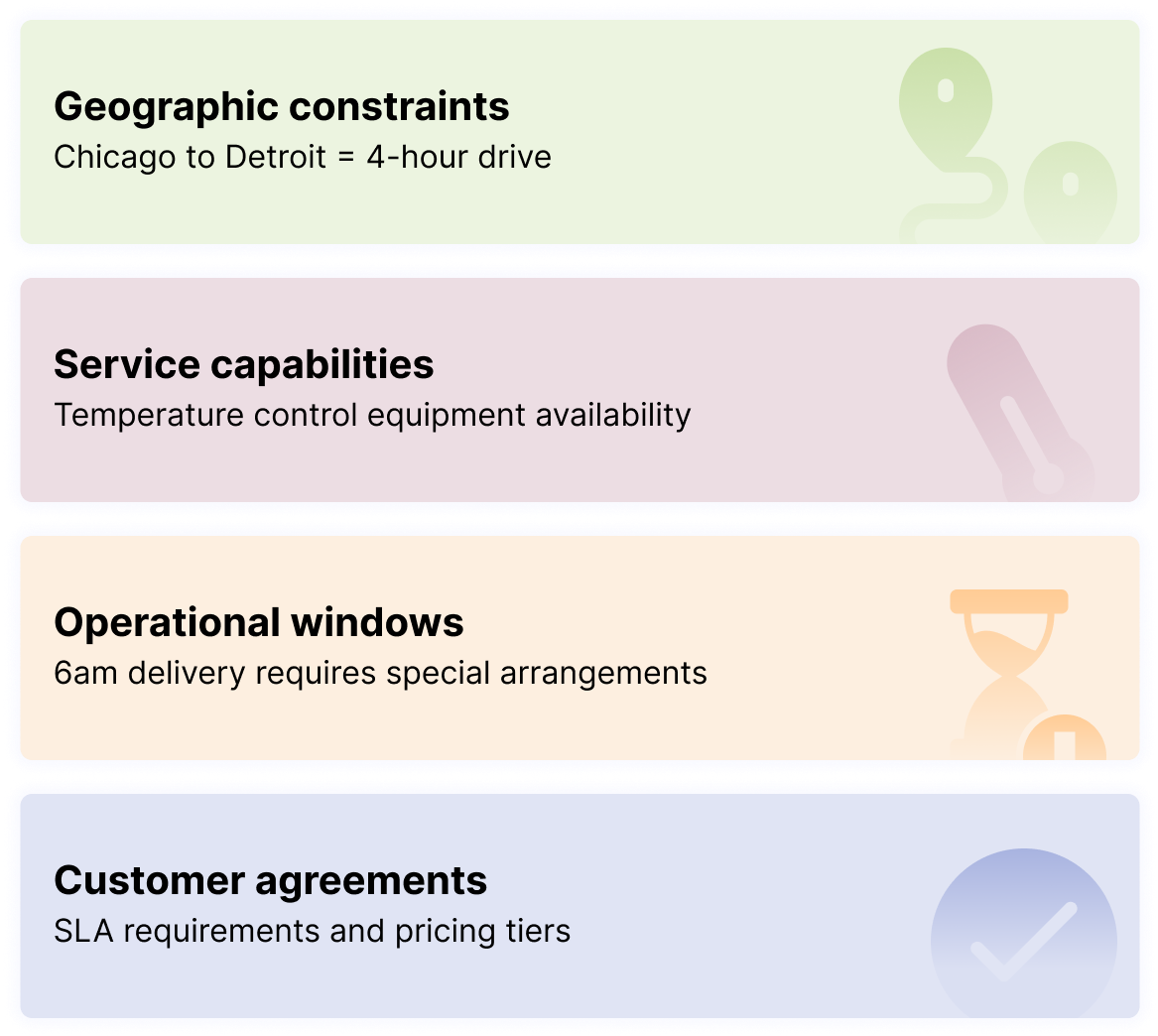
This semantic validation catches errors that pure extraction misses, enabling production accuracy.
The 32-Second Transformation
The results reveal what's possible when you solve semantic extraction correctly. Price quotes now average 32 seconds versus hours previously required.
The system processes over 2,000 daily pricing requests automatically. Over 10,000 routine email transactions now complete in seconds rather than hours.
But here's the real insight: the speed improvement came from understanding document structure, not improving text extraction speed.
Meghan Hughes, Key Account Manager, describes the impact: "Employees are now freed up to do higher-value work, solving greater challenges for 2,720 of C.H. Robinson's customers so far."
The financial results validate the approach. 15% productivity increase in 2024. Q4 gross profits up 10.4% to $672.9 million. Operating margin expanded 940 basis points to 26.8%.

What This Means for Your Document Processing Strategy
Stop optimizing OCR accuracy. Start building semantic understanding. Your documents contain implicit data structures that traditional extraction completely misses. Focus on understanding document semantics rather than improving text recognition.
Domain expertise beats generic algorithms. C.H. Robinson succeeded because they built logistics intelligence into their processing workflow. Generic document AI platforms failed because they lacked freight industry knowledge. Your success depends on encoding business logic into extraction processes.
Validation enables automation. Production accuracy comes from understanding what extracted data should look like within your business context. Build validation rules that understand operational constraints, business relationships, and domain-specific requirements.
The competitive advantage belongs to companies that solve document processing problems their competitors consider impossible. C.H. Robinson proved that semantic extraction can handle complexity that breaks traditional approaches.
PS: If your business documents contain hidden data structures that standard OCR can't extract, your automation strategy should prioritize semantic understanding over text extraction improvements. At Docsumo, we help enterprises achieve 95%+ accuracy on complex documents by building domain-specific intelligence into processing workflows rather than relying on generic OCR improvements. The companies that solve semantic extraction first will capture disproportionate competitive advantage while their competitors struggle with traditional approaches.
PPS: A lot of the case study was simplified through examples that are made up as their dataset isn’t public
If you need help with anything document processing, hit reply and let us help :)